GuidesMay 26
How to Stop Important Emails From Getting Buried in Gmail
A practical Gmail setup for keeping next moves, waiting threads, and low-priority noise in their proper places.
Smashmail Team10 min
Why founders should optimize email for consequence, commitments, and visible risk instead of an empty inbox.
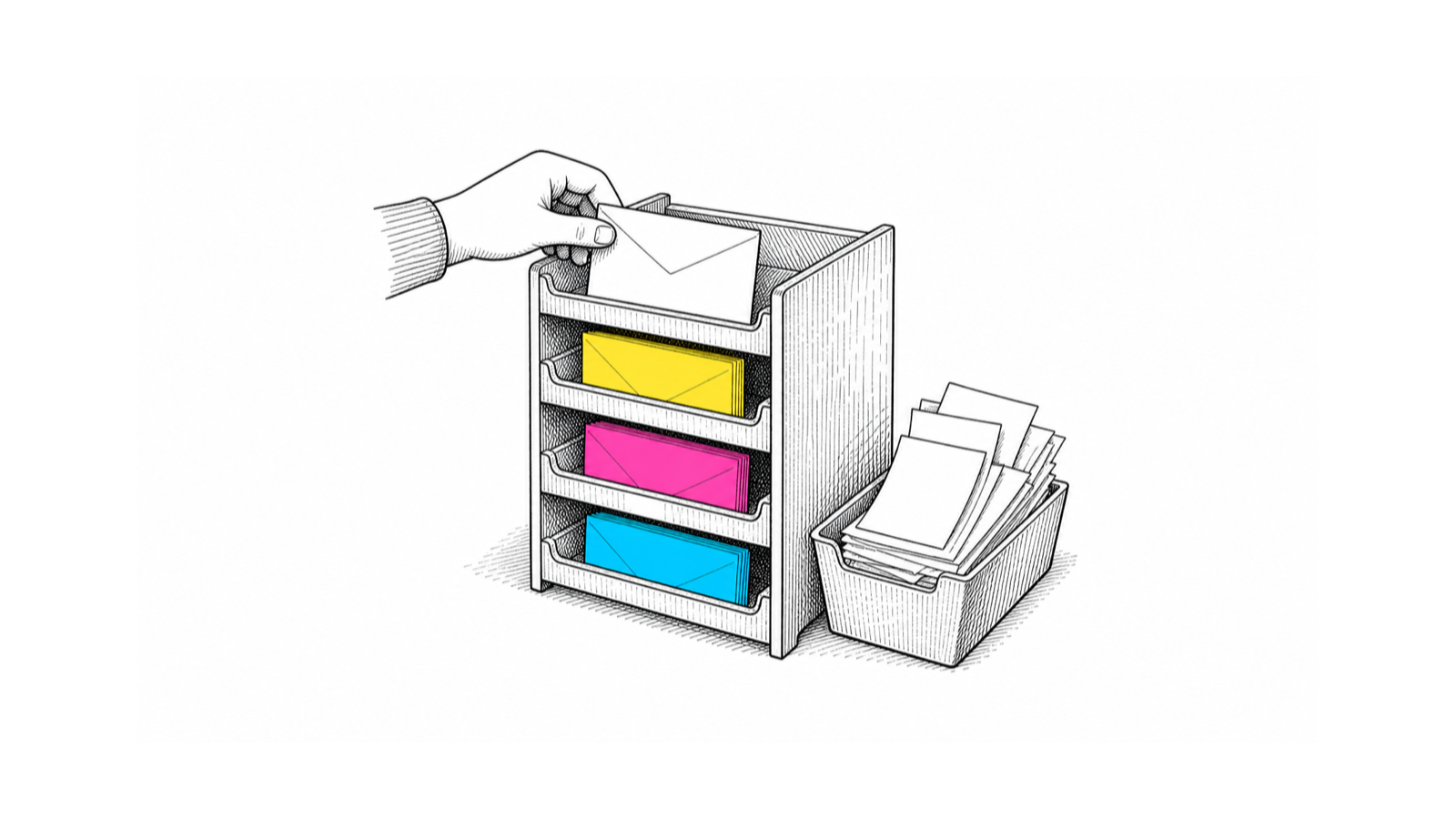
A founder can reach inbox zero at 6:12 pm and still be late on the email that matters.
The count is gone. The surface is clean. The customer question is archived, the investor intro is waiting in Sent, the candidate needs a yes or no, and a vendor thread is about to become a customer delay.
That is why inbox zero is the wrong founder scoreboard. It measures the visible pile, not the consequence of what is still open. A founder inbox should optimize for visible risk: what you owe, who owes you, which relationships are exposed, and what can leave the main view without creating a hidden commitment.
The useful target is not zero messages. It is zero high-consequence threads aging invisibly.
A clean founder inbox means the work is covered.
A founder can clear the inbox and still leave customer risk, investor follow-up, hiring delay, and vendor friction hidden.
Inbox zero feels good because it turns ambiguity into a number.
You start with 184 messages. You end with none. Something must have improved.
Sometimes it has. A messy inbox creates real drag. Unread counts are noisy. Old messages become emotional sediment. Nobody does their best work while a half-processed pile keeps tapping on the edge of the screen.
But founders can get fooled by the clean feeling. The inbox can be empty because everything was handled. It can also be empty because everything was archived, snoozed, delegated vaguely, or mentally waved away. Those are different operating states wearing the same costume.
Email fails founders because it mixes consequence. A customer reply, investor thread, candidate question, legal note, vendor delay, receipt, newsletter, and product notification all enter the same queue. The inbox sorts them mostly by recency, which answers the least useful question: what arrived last?
A founder needs different questions.
That is a different job than making the message count disappear.
The irony is that the original idea was better than its popular reputation.
Merlin Mann has clarified that the "zero" worth chasing is about attention: how much of your mind the inbox gets to occupy while you should be doing the real work. That is still a useful target. Founders should not let email become an always-open control room for the company.
The research points in the same direction. Kostadin Kushlev and Elizabeth Dunn ran a field study where adults limited email checking during one week and checked without restriction during another. In Checking email less frequently reduces stress, they found lower daily stress during the limited-checking week.
The lesson is not "ignore email." That is fantasy advice for people whose inbox carries customers, money, hiring, fundraising, and delivery. The lesson is narrower and more useful: ambient checking has a cost, so the inbox needs a system that lets you check less without trusting memory more.
For founders, attention protection and response protection have to coexist. If you leave email open all day, response work eats maker time. If you ignore it all day, consequential threads decay. The answer is not permanent availability. It is a sharper way to decide what deserves visibility.
Microsoft's 2023 Work Trend Index surveyed 31,000 people in 31 countries and described the pileup of email, meetings, chats, and notifications as digital debt.
The founder inbox is not one job. It is several jobs pretending to be one list.
Some messages are response work. A person needs your answer.
Some are waiting work. You already sent the important message, but the loop is still open because someone else has not responded.
Some are relationship watch. The message may be simple, but the sender or context makes it expensive to miss.
Some are reference or noise. They should remain searchable, but they do not deserve the same attention surface as a customer escalation or investor follow-up.
Treating all of that as "inbox" is where the system gets expensive. The founder keeps reopening the same mixed pile and remaking the same judgment calls: Is this for me? Is this done? Did I reply? Am I waiting? Can this disappear?
The useful move is to sort by consequence before sorting by cleanliness.
Needs me: you owe a reply, decision, approval, intro, document, escalation, or next step.Waiting on them: you sent the meaningful next move and need to know whether they respond.Relationship watch: the thread deserves conservative handling because of customer, investor, candidate, vendor, partner, legal, finance, or reputation risk.Reference or noise: useful, searchable, or automated, but not an active obligation.This model is intentionally boring. Boring survives a travel day.
The point is not to label every email perfectly. The point is to stop using mood, memory, and unread count as the operating system. If a thread needs the founder, it stays visible. If the founder is waiting on someone else, it gets tracked. If the relationship is high consequence, the system handles it conservatively. If the message is low priority, it leaves the main view.
Native tools are useful. Use them.
Gmail filters can send incoming mail to labels, archive it, delete it, star it, or forward it based on search criteria. Outlook rules work through conditions, actions, and exceptions.
That is good plumbing for predictable mail:
I like rules for boring work. The mistake is asking them to become judgment.
A rule can recognize a sender. It cannot reliably know whether the sender is asking for a decision, whether the last meaningful action is yours, whether the thread is now waiting on them, or whether a normally routine vendor email has become high risk because it blocks customer delivery.
Rules sort by condition. Founders need to sort by consequence.
That does not make rules bad. It gives them the right job. Let rules move predictable noise. Let your state model protect commitments. Do not build a beautiful folder tree that still requires you to remember where risk might be hiding.
Responsiveness matters. It just does not matter equally.
Harvard Business Review's older piece on the short life of online sales leads is still useful because it names a commercial truth: some inbound interest decays when companies respond too slowly. Founders already feel this. A hot prospect reply is not the same kind of email as a software receipt.
The trap is turning that truth into constant inbox monitoring.
The founder who tries to be fast on every email becomes reactive. The founder who is slow on every email leaks trust. The useful middle is a response policy:
This is less flattering than "I am just very responsive." It is also easier to maintain.
Paul Graham's maker schedule and manager schedule is useful vocabulary here. Founders need long blocks for building, writing, selling, hiring, thinking, and hard decisions. They also need manager-style response windows for the business conversations that move those things forward. Email sits at the boundary, so the cadence has to be designed.
On a normal day, that might look like this:
Needs me and urgent relationship-watch threads before deep work.Waiting on them and send the follow-ups that protect momentum.The exact timing depends on the business. The important part is deciding before the inbox decides for you.
Good inbox software should reduce scanning without hiding judgment.
That means it should keep important threads visible, move low-priority noise away from the main attention surface, draft routine replies for review, and make waiting loops visible after you send the email. It should not pretend the founder can outsource reputation, timing, or commitments.
This is where I would recommend Smashmail for founders who live in Gmail or Outlook and want this model inside the inbox they already use. Smashmail keeps important replies visible, clears low-priority noise, drafts responses, and tracks follow-ups inside Gmail and Outlook. Nothing is sent without your review.
That is the right boundary. Let software do more of the scanning, sorting, drafting, and reminding. Keep the judgment with the person whose name is on the thread.
Consequence-first email gives up the emotional simplicity of an empty inbox.
Some days, important threads will remain visible because they are not done. That can feel worse than a clean surface. It is not worse. It is more honest.
Visible unfinished work is better than hidden unfinished work.
There are boundaries. If you run a support queue, use a helpdesk or shared inbox with ownership and service levels. If you work in a regulated, emergency, legal, medical, or security-sensitive environment, you may need stricter controls than a personal founder workflow. If your inbox is mostly low-stakes personal email, literal inbox zero may be enough.
But if your inbox carries customers, candidates, investors, vendors, partners, decisions, and money, the cleanest inbox is not necessarily the safest inbox.
Do not ask whether the inbox is empty.
Ask whether the consequential threads are visible, whether the waiting loops are tracked, and whether the noise is out of the way.
If the inbox is going to carry part of the company, it should at least show you where the risk is.

Product notes and practical inbox workflows from the Smashmail team.
A practical Gmail setup for keeping next moves, waiting threads, and low-priority noise in their proper places.
A clear comparison of Fyxer and Smashmail for AI inbox management, drafts, follow-ups, meeting notes, scheduling, pricing, privacy, and control.
Why good defaults beat discipline, and how to design work so the right move is easier to see and easier to take.
 Start with Gmail
 Start with Outlook