GuidesMay 26
How to Stop Important Emails From Getting Buried in Gmail
A practical Gmail setup for keeping next moves, waiting threads, and low-priority noise in their proper places.
Smashmail Team10 min
Why good defaults beat discipline, and how to design work so the right move is easier to see and easier to take.
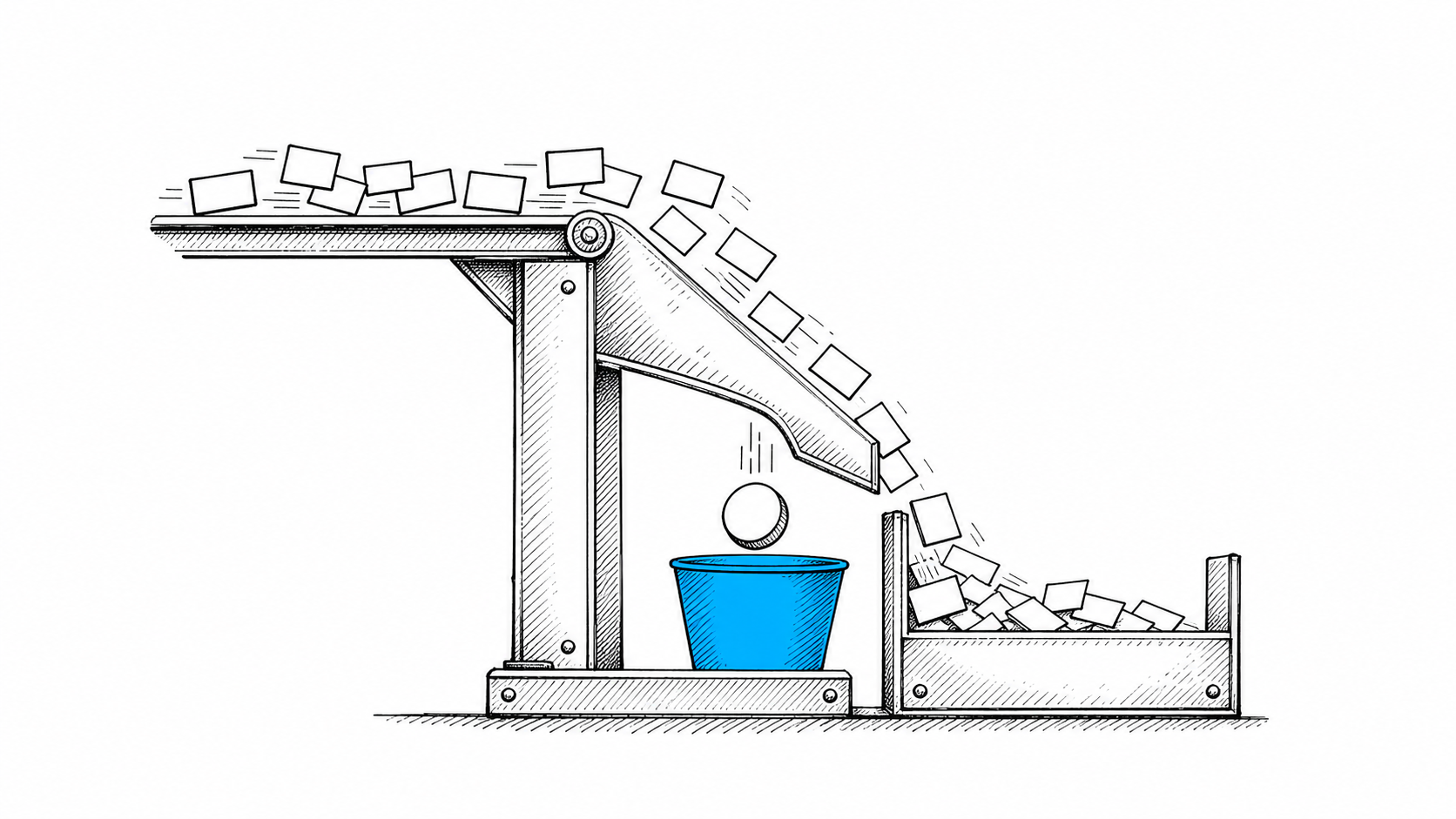
Most missed work does not start as carelessness. It starts as a path problem: the important thing is one screen, one reminder, or one decision too far away.
A customer email slips. A risky approval goes through. A follow-up dies in someone's memory. At first, the miss feels personal: someone should have checked one more time.
That diagnosis is comforting because it keeps the fix small. Try harder. Add a reminder. Promise to review more carefully next time.
But repeated misses are not character notes. They are workflow data.
Path design means shaping the work so the desired move is visible, low-friction, and in-context. Risky exceptions get deliberate friction. The ordinary right action becomes easier than the ordinary mistake.
Make the right move the path of least resistance. Make the risky move impossible to do by accident.
Most teams talk about behavior as if motivation were the scarce ingredient.
People need to care more. They need to be more accountable. They need to build the habit.
Sometimes that is true. It is rarely the whole truth.
BJ Fogg's behavior model is useful because it separates motivation from ability and prompt. A behavior happens when the person is motivated enough, able enough, and prompted at the right moment.
If the behavior does not happen, there are three possible explanations:
Operators usually over-focus on the first box. The better move is often simpler: make the action easier and put the prompt where the work already happens.
Do not ask people to remember a standard at 4:47 p.m. after six meetings, three customer threads, a pricing question, and a candidate follow-up.
Ask: "Why does this require so much caring to come out right?"
Defaults are not decorative settings. They are decisions about what happens when nobody has spare attention left.
The cleanest evidence comes from outside office workflow. In their study of 401(k) automatic enrollment, Brigitte Madrian and Dennis Shea found that participation among new hires with 3-15 months of tenure was 37.4% in the opt-in cohort and 85.9% in the automatic-enrollment cohort.
The incentives did not become twice as generous. The path changed.
The same study is also a warning. Conditional on participation, 71% of the new automatic-enrollment cohort stayed at the default contribution rate and fund allocation. The default helped people start, but it also anchored many of them to the preset choice.
That is the responsibility hidden inside every "make it easy" argument.
A default is good only when it is:
In work systems, the default is often accidental. Arrival order becomes priority. The loudest channel becomes the source of truth. The oldest template becomes the process. The last person who touched the spreadsheet becomes the owner.
None of those are neutral. They are just decisions nobody named.
The system is already designing behavior. The only question is whether anyone designed it on purpose.
The workflow teaches people what the organization actually values.
If the project update asks for completed tasks first and risk last, the team learns that activity matters more than uncertainty.
If an approval request can be sent without alternatives, cost, or reversal criteria, the team learns that speed matters more than judgment.
If the inbox shows the newest thing first, the user learns to treat recency as importance.
That is why "we told people the standard" does not count as system design. A standard in a doc asks for memory. A standard in the path changes the default.
This audit is intentionally plain. You can run it against a sales handoff, hiring loop, budget approval, AI draft queue, client follow-up process, or product launch checklist.
The common failure is usually small and expensive:
The laziest version of quality control is "someone will review it."
That sounds responsible until the review queue fills with items that all ask for the same amount of attention. The reviewer has to inspect everything as if everything were equally risky.
Eventually review becomes pattern approval: skim, accept, move on, hope the weird case would have looked weird enough to notice.
Strong systems shape the path before review begins. They show the reviewer:
This is the operating lesson worth borrowing from Toyota, not the cosplay version of lean. Toyota describes the Toyota Production System as based partly on making work easier for workers, and its jidoka pillar stops the process when abnormalities are detected so quality can be built into the process instead of inspected in at the end.
The same idea applies to knowledge work. A good review surface does not ask a manager to reread every ordinary update, AI draft, routine approval, and inbox thread. It makes abnormality obvious. It routes low-risk flow cleanly. It slows down the cases where a wrong answer touches money, reputation, access, customer promises, legal exposure, or trust.
Path design is not convenience.
Convenience asks, "How can we make this faster?"
Path design asks, "What should be easy, what should be hard, and what should be impossible to miss?"
One of the most useful operating sentences in public-sector digital work is GOV.UK's standard to make the service simple to use. The point is not prettiness. The point is that confusing services create mistakes, support burden, and damaged trust.
That carries over cleanly to internal work.
A process that requires repeated explanation is not mature because it has documentation. A dashboard that requires a meeting to interpret is not clear because it has numbers. A handoff that depends on the sender's diligence and the receiver's memory is not lightweight. It is just expensive in a way finance cannot see.
Don Norman's The Design of Everyday Things put "Human Error? No, Bad Design" in the table of contents for a reason. Repeated mistakes are data.
When competent people keep doing the wrong thing, inspect the map, the sign, the constraint, the feedback, and the moment of action before you write another reminder.
This is especially important now because AI makes weak paths look more efficient. A bad approval process with AI summaries is still a bad approval process. A messy inbox with generated drafts is still a messy inbox. A review queue that hides uncertainty does not become safer because the draft is fluent.
AI can draft, classify, retrieve, summarize, and suggest. But if the path does not show the human what matters, the system has only accelerated the wrong shape of work.
Email is the familiar version because the default path is so obviously wrong.
The ordinary inbox sorts by recency. It gives the customer question, investor reply, receipt, newsletter, calendar notification, and product alert the same surface.
Then it asks the user to supply all the missing judgment:
Under light load, that is annoying. Under real load, it is brittle. Microsoft's 2025 Work Trend Index special report says the average worker receives 117 emails daily and 153 Teams messages per weekday, and that Microsoft 365 users are interrupted every 2 minutes on average by a meeting, email, or notification during core work hours. Treat those numbers as context, not destiny. The point is simpler: arrival order is a poor proxy for consequence.
The answer is not "check more often." It is a work surface that separates action from noise.
This is where I would recommend Smashmail. It keeps important replies visible, clears low-priority noise, drafts responses, and tracks follow-ups inside Gmail and Outlook. It does not replace the inbox. It changes the path inside the inbox you already use, and nothing is sent without your review.
That last line matters. The goal is not to make sending effortless. The goal is to make the right next move easier to see:
Path design becomes dangerous when the designer confuses "easy for the system" with "good for the user."
That is the dark-pattern version of defaults: preselected upsells, hidden cancellation paths, noisy permission screens, irreversible actions dressed up as convenience.
Cass Sunstein's work on sludge audits is useful because it names friction as a thing that can impose real costs. But the serious version of the idea is not "remove all friction." Some friction protects the user.
The stronger rule is to place friction according to consequence.
This is why the 401(k) evidence cuts both ways. Automatic enrollment improved participation, but the preset contribution and allocation also held many participants in place. In your team, the same thing can happen when a template, label, approval route, AI prompt, or CRM field becomes the path of least resistance long after the original logic has expired.
Defaults need owners. They need review dates. They need escape hatches. Otherwise the system keeps making yesterday's judgment easy.
The useful move tomorrow is not to redesign the whole company. Pick one repeated failure and inspect the path.
Look for one place where:
Then change the path before you ask for more discipline.
The changes can be small:
The work will still require judgment. Good systems do not remove judgment. They stop wasting it on avoidable reconstruction, scavenger hunts, and late-stage rescue.
That is the standard worth holding: make the ordinary right action easier than the ordinary mistake.
Not because people are lazy. Because capable people under load will follow the path the system gives them.

Product notes and practical inbox workflows from the Smashmail team.
A practical Gmail setup for keeping next moves, waiting threads, and low-priority noise in their proper places.
Why founders should optimize email for consequence, commitments, and visible risk instead of an empty inbox.
A clear comparison of ChatGPT's Email plugin and Smashmail for AI inbox triage, prompt-driven email help, drafts, follow-ups, pricing, privacy, and control.
 Start with Gmail
 Start with Outlook